Choosing between a semi-automatic and a manual espresso machine depends on your desired level of control and brewing involvement. Manual machines offer complete control over pressure and flow via a lever, ideal for connoisseurs seeking nuanced flavors, while semi-automatic machines use an electric pump for consistent pressure, balancing user control with automated convenience, making them popular for home baristas.
What is an Espresso Machine?
An espresso machine is a specialized device that brews coffee by forcing nearly boiling water under high pressure (ideally around 9 bars) through finely ground coffee beans. This 20-30 second process extracts concentrated coffee, characterized by a thick, golden-brown foam layer called crema. Espresso machines revolutionized coffee drinking by enabling quick, potent, and rich beverages.
Historically, espresso machines evolved from steam-driven models to today’s precise piston and pump-driven designs. Modern machines typically include a water reservoir, a heating element (boiler or thermoblock), a pump, a group head for brewing, a portafilter for coffee grounds, and often a steam wand for milk frothing. The core principle involves heating water and then using pressure to efficiently extract soluble compounds from the coffee. For shop curated home espresso on this site.
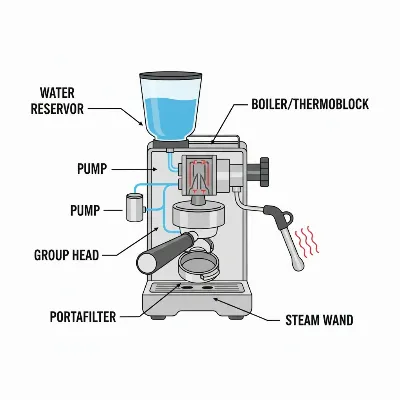 Detailed diagram of an espresso machine showing its main components like boiler, pump, portafilter, and steam wand.
Popular Types of Espresso Machines
The espresso machine market offers various options, catering to different skill levels, desired control, and convenience needs. Understanding each type is crucial for finding your perfect match.
Manual Espresso Machine
A manual espresso machine, often called a lever machine, embodies traditional espresso making. Users manually operate a lever to generate brewing pressure, allowing unparalleled control over variables like pressure profiling, pre-infusion duration, and water flow rate. This hands-on approach fosters a deep understanding of brewing and can produce exceptional, nuanced espresso shots.
- Pros: Full Control: Offers precise control over pressure and flow, enabling personalized extraction profiles. Exceptional Flavor: Many connoisseurs believe manual machines produce the richest, most complex espresso shots when mastered. Durability & Aesthetic: Often feature robust, simple designs with fewer electronic parts, contributing to longevity and a classic aesthetic. Compact & Portable: Some manual models are highly compact and don’t require electricity, making them ideal for travel or small spaces.
- Cons: Steep Learning Curve: Requires significant skill, practice, and patience for consistent results. Time-Consuming: The entire process, from grinding to cleaning, takes more time per shot. Requires Additional Tools: A high-quality grinder, tamper, and other accessories are essential and usually purchased separately. Inconsistent Results: Until mastered, shot quality can vary significantly.
- Best for: The true coffee aficionado who views espresso making as a craft, enjoys the ritual, and is dedicated to mastering every aspect of brewing. It’s also great for those who appreciate the aesthetic appeal of traditional machines or need a portable solution.
Semi-Automatic Espresso Machine
Semi-automatic espresso machines balance manual control and automated convenience, making them popular among home baristas and professional cafés. These machines use an electric pump for consistent water pressure and temperature but allow the user to control the start and stop of the espresso shot, grind size, and tamping pressure. This hybrid approach offers significant control over extraction without the strenuous physical effort of fully manual levers.
- Pros: Balanced Control: Automates water pressure and temperature while allowing the user to influence key variables like shot duration and grind. Consistent Results: Easier to achieve consistent, high-quality espresso shots compared to manual machines, thanks to automated pressure. Versatility: Equipped with steam wands, they are excellent for crafting a wide range of milk-based beverages like lattes and cappuccinos. Easier Learning Curve: While still requiring skill, the learning process is generally less daunting than with manual machines.
- Cons: Requires Skill: Still demands knowledge of grind size, tamping, and extraction timing for optimal results. Separate Grinder Often Needed: Most semi-automatic machines do not include a built-in grinder, requiring an additional purchase. Maintenance: Requires regular cleaning, backflushing, and descaling to maintain performance. Space & Cost: Generally larger and more expensive than basic manual machines.
- Best for: Enthusiasts who want a hands-on brewing experience and control over their espresso but prefer the consistency and ease of pump-driven pressure. Ideal for those who enjoy making milk drinks and are willing to invest time in learning.
Automatic Espresso Machine
Automatic espresso machines offer more convenience than semi-automatics. They use an electric pump and feature pre-programmed settings that automatically dispense a specific volume of water, stopping the shot on their own. This eliminates the need for manual flow stoppage, ensuring consistent shot volumes with every brew.
Super-Automatic Espresso Machine
For ultimate convenience, super-automatic espresso machines handle almost every brewing step. With a single button press, they can grind fresh beans, dose and tamp coffee, brew espresso, and even steam and froth milk automatically. These “bean-to-cup” machines prioritize speed and simplicity, delivering consistent results with minimal user intervention.
Capsule Espresso Machine
Capsule or pod espresso machines prioritize ease of use and speed. They use pre-packaged coffee capsules, eliminating the need for grinding and tamping. While offering unparalleled convenience and minimal cleanup, they typically provide the least control over the brewing process and often limit coffee selection to proprietary capsules.
Comparison Table of Espresso Machine Types
|
Our Picks for the Best Espresso Machine in 2026
As an Amazon Associate I earn from qualifying purchases.
|
||
| Num | Product | Action |
|---|---|---|
| 1 | Espresso Machine with Milk Frother, 20 Bar Pressure Espresso Maker, with 44OZ Removable Tank, Compact Stainless Steel Coffee Machine for Home, Office, Latte, Cappuccino, Gift for Women or Men |

|
| 2 | 20 Bar Espresso Coffee Machine with LED Touch Screen, Espresso Maker with Self-Cleaning Function & Milk Frother, Compact Cappuccino & Latte Maker for Home and Office |
|
| 3 | Breville Barista Touch Espresso Machine BES880BSS, Brushed Stainless Steel |
|
| 4 | SHARDOR Espresso Machine 20 Bar, Professional Espresso Machine with Milk Frother and Touchscreen, Expresso Coffee Machines with Adjustable Temperature,for Cappuccino, Latte |
|
| 5 | Gevi Commercial Espresso and Coffee Makers, Professional 20 Bar Espresso Maker with Milk Frother, Stainless Steel Expresso Coffee Machines for Home, Compact Cappuccino Machine, Great Gift |
|
| 6 | Chefman CraftBrew Espresso Machine, 15-Bar Pump Digital Espresso Maker w/Steam Wand for Latte & Cappuccino, Compact Espresso Coffee Machine w/ 1.5L Removable Water Reservoir - Stainless Black |
|
| 7 | Espresso Machine, 20 BAR Pump Temperature Control, Compact Espresso Maker with Steam Milk Frother, Professional Coffee Makers for Home, Cappuccino, Latte, Gifts for Coffee Lover, Black |
|
| 8 | Espresso Machine, 20Bar Compact Stainless Espresso Maker, With Milk Frother Steam Wand, 57.5OZ Removable Water Tank, Displays Making Time & Water Temperature, Cold Brew & Cappuccino, Silver |
|
| 9 | 20Bar Espresso Machine, Compact Espresso Maker with Milk Frother, Stainless Steel Coffee Machine for Cappuccino&Latte, 42oz Water Tank, Visible Pressure Gauge, Home&Office, Silver |
|
| 10 | Espresso Machine 20 Bar with Milk Frother, Stainless Steel Coffee Maker with 42 oz Removable Water Tank for Cappuccino, Latte&Cold Brew, Home&Office, Silver |
|
| Feature | Manual | Semi-Automatic | Automatic | Super-Automatic | Capsule |
|---|---|---|---|---|---|
| Level of Control | Very High | Medium-High | Medium | Very Low | Very Low |
| Complexity | High | Medium | Medium | Low | Very Low |
| Price Range | Medium | Medium-High | High | Very High | Low |
| Maintenance | High | Medium | Medium-High | Medium-High | Low |
| Coffee Quality | Excellent (with skill) | Excellent (with skill) | Good | Good | Low-Medium |
Espresso Machine Buying Guide
Choosing the right espresso machine is a significant investment for any coffee lover. Consider these factors to ensure your selection perfectly aligns with your lifestyle and brewing aspirations.
- Determine Your Usage Needs: The volume of coffee you expect to make daily influences the machine’s capacity and speed. A manual machine suits a thoughtful morning ritual, while a semi-automatic can handle multiple milk-based drinks for entertaining.
- Set Your Budget: Espresso machines vary widely in price. Manual machines can be affordable at entry-level, though high-end lever models can be substantial. Semi-automatics represent a broad middle ground, while super-automatics are generally the most expensive upfront. Factor in the cost of essential accessories like a quality grinder for manual and semi-automatic machines.
- Essential Features: Consider non-negotiable functions. Do you need a powerful steam wand for lattes? Is an integrated grinder a must-have (found in some semi-automatics and most super-automatics)? Do you desire programmable shot volumes or temperature control (PID)? These features significantly impact cost and user experience.
- Brand Reputation: Research reputable brands known for quality, reliability, and customer support. Brands with a long history in espresso machine manufacturing often provide better build quality and easier access to parts and service.
- Size and Design: Espresso machines can take up significant counter space. Measure your available area and choose a machine that fits comfortably. Beyond practicalities, consider the aesthetic that best suits your kitchen decor. Manual and semi-automatic machines often boast classic, elegant designs.
- Technical Specifications: Pay attention to power (wattage), pump pressure (9 bars is standard for espresso), and water reservoir capacity. Dual boiler systems in semi-automatics offer superior temperature stability for simultaneous brewing and steaming, a feature for serious enthusiasts.
- Warranty and Support: A robust warranty and accessible customer support are vital. Knowing you have technical assistance and parts availability can save headaches down the line, especially for more complex machines.
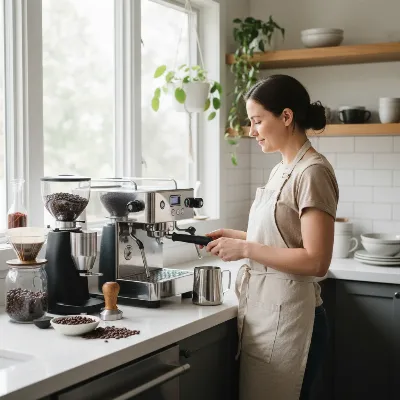 A home barista carefully choosing an espresso machine in a modern kitchen, surrounded by various coffee accessories.
Top Semi-Automatic vs. Manual Espresso Machine Qualities
When considering the best machines in each category, it’s less about specific models and more about the underlying qualities that define excellence for a “top” manual or semi-automatic espresso machine.
For manual espresso machines, the best models prioritize precision engineering and material quality. They offer robust lever mechanisms that provide exceptional tactile feedback, allowing the user to finely “feel” and control the pressure profile throughout the shot. High-quality PIDs (Proportional-Integral-Derivative controllers) for temperature stability, durable stainless steel or brass components, and excellent heat retention are hallmarks. These machines are designed for longevity and offer the purest expression of the barista’s skill, allowing for deep experimentation with bean varieties and roast levels to achieve nuanced flavor profiles.
For semi-automatic espresso machines, top-tier models distinguish themselves through their advanced boiler systems and consistent performance. Dual boiler or heat exchanger systems are preferred, as they provide stable temperatures for both brewing and steaming, allowing for simultaneous operation without compromising espresso quality. PID temperature control is a standard feature, ensuring precise and repeatable brew temperatures. High-quality vibratory or rotary pumps contribute to quiet operation and consistent pressure. Robust build quality, often featuring stainless steel construction, and thoughtful design for ease of maintenance (like accessible internal components) are also key. These machines are built to be reliable workhorses, offering a superb balance of user control and automated consistency for daily use and entertaining.
How to Use and Maintain Your Espresso Machine
Regardless of your machine choice, proper usage and diligent maintenance are crucial for consistently great espresso and extending your machine’s lifespan.
Usage Tips:
- Grind Fresh: Always grind your coffee beans just before brewing. The correct grind size is critical—too fine will choke the machine, too coarse will result in weak, under-extracted espresso.
- Dose and Tamp: Measure your coffee dose accurately and tamp it evenly with consistent pressure into the portafilter basket. An uneven tamp can lead to channeling and poor extraction.
- Pre-infusion (if available): If your machine offers it, pre-infusion gently saturates the coffee grounds before full pressure is applied, leading to a more even extraction.
- Extract Your Shot: For semi-automatics, start the pump and observe the flow. Aim for a stream that looks like warm honey, producing 1.5-2 ounces of espresso in 25-30 seconds. Stop the flow manually when achieved. For manual machines, control the lever to achieve the desired pressure and flow profile.
- Steam Milk: For semi-automatics, purge the steam wand before and after use. Immerse the tip just below the surface of cold milk to create a vortex, incorporating air for desired foam texture, then lower the wand to heat the milk.
Maintenance for Longevity:
- Daily Cleaning: Immediately after each use, clean the portafilter and filter basket. Backflush the group head with water (and a cleaning solution periodically) to remove coffee oils. Wipe down the steam wand immediately after frothing to prevent milk from drying.
- Descaling: Regularly descale your machine (frequency depends on water hardness) to prevent mineral buildup, which can affect heating efficiency and flow. Use manufacturer-recommended descaling solutions.
- Replace Gaskets & Screens: Periodically inspect and replace worn group head gaskets and shower screens to maintain proper sealing and water distribution.
Essential Accessories For Your Espresso Journey
To truly improve your home espresso experience, a few key accessories are indispensable, especially for manual and semi-automatic users:
- High-Quality Coffee Grinder: This is arguably the most crucial accessory. A burr grinder (either conical or flat burr) designed for espresso will provide the consistent, fine grind necessary for proper extraction.
- Tamper: A well-weighted, appropriately sized tamper helps you apply even pressure to the coffee grounds, essential for consistent shots.
- Milk Pitcher: For milk-based drinks, a stainless steel milk pitcher with a spout is necessary for steaming and pouring latte art.
- Knock Box: A convenient container to easily dispose of spent coffee pucks from your portafilter.
- Cleaning Brushes and Cloths: Dedicated brushes for the group head and portafilter, along with microfiber cloths for wiping surfaces and the steam wand.
- Cleaning Detergent/Powder: Specific cleaners for backflushing and descaling ensure your machine remains free of coffee oils and mineral buildup.
- Digital Scale: A precise scale (to 0.1 gram accuracy) for weighing your coffee dose and espresso yield is invaluable for consistency and dialing in your shots.
Conclusion
The choice between a semi-automatic and a manual espresso machine ultimately boils down to your personal philosophy toward coffee brewing. Do you crave the tactile, artistic control of a manual lever machine, where every pull is a direct reflection of your skill and passion? Or do you prefer the balanced control and consistency offered by a semi-automatic, allowing for a more forgiving yet still highly customizable experience, especially for crafting milk-based beverages? Both paths lead to exceptional espresso, but they demand different levels of engagement and mastery.
As you embark on your espresso journey, consider your willingness to learn, your daily routine, and the kind of interaction you desire with your coffee. Whichever machine you choose, the pursuit of the perfect espresso shot is a rewarding adventure, rich with flavor and personal satisfaction. What kind of home barista do you aspire to be?
Frequently Asked Questions
What is the primary difference in control between manual and semi-automatic espresso machines?
The main difference lies in pressure generation. Manual machines require the user to physically apply force via a lever to create brewing pressure, offering full control over the pressure profile. Semi-automatic machines use an electric pump to automatically generate and maintain consistent pressure, with the user controlling the start and stop of water flow.
Do manual espresso machines always produce better coffee than semi-automatic ones?
Not necessarily. While manual machines offer the potential for exceptionally nuanced espresso due to absolute control, achieving consistency requires significant skill and practice. Semi-automatic machines can produce consistently excellent coffee with less effort due to automated pressure, making them a reliable choice for high-quality results.
What extra accessories are essential for a semi-automatic espresso machine?
Beyond the machine itself, a high-quality burr grinder is paramount for a semi-automatic machine, as grind consistency is crucial for extraction. A tamper, milk pitcher, knock box, and cleaning supplies are also vital for a complete and enjoyable brewing setup.
How much maintenance do these machines typically require?
Both manual and semi-automatic machines require regular cleaning to prevent buildup of coffee oils and mineral deposits. Daily cleaning of the portafilter, group head, and steam wand is recommended. Periodic backflushing and descaling are also necessary, with frequency depending on usage and water hardness, to ensure longevity and optimal performance.
Can beginners effectively use a manual or semi-automatic espresso machine?
Beginners can certainly use both, but the learning curve differs significantly. Semi-automatic machines are generally more approachable for beginners due to automated pressure. Manual machines have a steeper learning curve, demanding more patience and dedication to master, but offer immense rewards for those committed to the craft.
Frequently Asked Questions
What is the primary difference in control between manual and semi-automatic espresso machines?
The main difference lies in pressure generation. Manual machines require the user to physically apply force via a lever to create brewing pressure, offering full control over the pressure profile. Semi-automatic machines use an electric pump to automatically generate and maintain consistent pressure, with the user controlling the start and stop of water flow.
Do manual espresso machines always produce better coffee than semi-automatic ones?
Not necessarily. While manual machines offer the potential for exceptionally nuanced espresso due to absolute control, achieving consistency requires significant skill and practice. Semi-automatic machines can produce consistently excellent coffee with less effort due to automated pressure, making them a reliable choice for high-quality results.
What extra accessories are essential for a semi-automatic espresso machine?
Beyond the machine itself, a high-quality burr grinder is paramount for a semi-automatic machine, as grind consistency is crucial for extraction. A tamper, milk pitcher, knock box, and cleaning supplies are also vital for a complete and enjoyable brewing setup.
How much maintenance do these machines typically require?
Both manual and semi-automatic machines require regular cleaning to prevent buildup of coffee oils and mineral deposits. Daily cleaning of the portafilter, group head, and steam wand is recommended. Periodic backflushing and descaling are also necessary, with frequency depending on usage and water hardness, to ensure longevity and optimal performance.
Can beginners effectively use a manual or semi-automatic espresso machine?
Beginners can certainly use both, but the learning curve differs significantly. Semi-automatic machines are generally more approachable for beginners due to automated pressure. Manual machines have a steeper learning curve, demanding more patience and dedication to master, but offer immense rewards for those committed to the craft.
How to Use and Maintain Your Espresso Machine
Proper usage and diligent maintenance are crucial for consistently great espresso and extending your machine's lifespan, regardless of whether you choose a manual or semi-automatic model.
Always grind your coffee beans just before brewing. The correct grind size is critical: too fine will choke the machine, while too coarse will result in weak, under-extracted espresso. Aim for a consistent, fine grind suitable for espresso.
Measure your coffee dose accurately and tamp it evenly with consistent pressure into the portafilter basket. An uneven tamp can lead to channeling, where water finds paths of least resistance, resulting in poor extraction and an inconsistent shot.
For semi-automatics, start the pump and observe the flow, aiming for a stream like warm honey, producing 1.5-2 ounces of espresso in 25-30 seconds, then stop manually. For manual machines, control the lever to achieve your desired pressure and flow profile throughout the extraction.
Immediately after each use, clean the portafilter and filter basket. Backflush the group head with water (and a cleaning solution periodically) to remove coffee oils. Wipe down the steam wand immediately after frothing to prevent milk from drying and hardening.
Regularly descale your machine (frequency depends on water hardness, typically every 1-3 months) to prevent mineral buildup. Mineral deposits can significantly affect heating efficiency and water flow, so use manufacturer-recommended descaling solutions for optimal performance and longevity.
Get our weekly buyer guide
Practical specs, not advice. Unsubscribe anytime.

I’ve been using a semi-automatic for years, but after reading about the control a manual machine offers, I decided to take the plunge. The difference in flavor is incredible! Being able to really dial in the pressure with the lever has elevated my morning espresso to a whole new level. It’s definitely more hands-on, but totally worth it for the nuanced flavors.
I appreciate the breakdown of manual vs. semi-automatic. I’ve always leaned towards the convenience of an electric pump, and my current machine consistently hits that 9 bars of pressure without me having to think about it. While the idea of full control is tempting, I’m happy with the balance my semi-automatic provides for my busy mornings. Great info for anyone on the fence!
I got a manual machine hoping to really get into the craft, but it’s been a bit of a learning curve. The 20-30 second extraction time is harder to hit consistently than I thought, and my crema isn’t always as thick as I’d like. I’m still practicing, but sometimes I wish I had the automated consistency of a semi-automatic.
As someone who loves experimenting with different roasts, the complete control over pressure and flow on my manual machine is a game-changer. It really lets me bring out the unique characteristics of each bean. It’s definitely for the connoisseur, and I wouldn’t go back to anything else now that I’ve experienced this level of customization.